การพัฒนาผลิตภัณฑ์สบู่เหลวต้านอนุมูลอิสระกระเจี๊ยบแดงและสบู่เหลวกระเจี๊ยบแดงผสมสครับกากกาแฟ
Article Sidebar
Main Article Content
Abstract
Development of Antioxidant Roselle Liquid Soap and Roselle–Coffee Grounds Scrub Liquid Soap Products
Piyawan Phansi*
Department of Chemistry, Faculty of Science and Technology, Thepsatri Rajabhat University, Lopburi 15000, Thailand
Pimmada Klaythongpan
Department of Chemistry, Faculty of Science and Technology, Thepsatri Rajabhat University, Lopburi 15000, Thailand
Siraprapha Raksaphakdee
Department of Chemistry, Faculty of Science and Technology, Thepsatri Rajabhat University, Lopburi 15000, Thailand
*E-mail: piyawan.p@lawasri.tru.ac.th
รับบทความ: 8 ธันวาคม 2568; แก้ไขบทความ: 26 กุมภาพันธ์ 2569; ยอมรับตีพิมพ์: 6 มีนาคม 2569; บทความออนไลน์: 10 มิถุนายน 2569
บทคัดย่อ
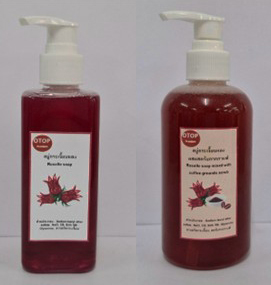
งานวิจัยนี้เป็นการพัฒนาผลิตภัณฑ์สบู่เหลวที่มีการเติมสารสกัดกระเจี๊ยบแดง (Hibiscus sabdariffa L.) ซึ่งเป็นสมุนไพรที่ปลูกในท้องถิ่นพื้นที่จังหวัดลพบุรี และผลิตภัณฑ์สบู่เหลวที่มีการเติมสารสกัดกระเจี๊ยบแดงและสครับกากกาแฟ (Coffea arabica L.) เพื่อเป็นการเพิ่มฤทธิ์ต้านอนุมูลอิสระของสบู่ และเติมสีสันของสบู่เหลวจากสีธรรมชาติ โดยงานนี้ได้ศึกษาคุณภาพของสบู่เหลวและศึกษาฤทธิ์การต้านอนุมูลอิสระของสบู่ด้วยวิธีดีพีพีเอช จากการทดลองศึกษาเปรียบเทียบสูตรสบู่เหลว 7 สูตร ผลการทดลองพบว่า ค่าสีของสบู่เหลว (ค่า L* a* และ b*) ที่ได้จากการวัดด้วยเครื่องวิเคราะห์ค่าสีมีความแตกต่างกัน สบู่เหลวมีค่า pH 4.01–6.67 ซึ่งอยู่ในเกณฑ์มาตรฐานสบู่เหลวสมุนไพรตามมาตรฐานอุตสาหกรรม (มอก.14–2562) ค่าปริมาตรฟองอยู่ระหว่าง 69.33±1.53 ถึง 71.67±1.53 มิลลิลิตร ความคงทนของฟอง 61.00±1.00 ถึง 62.33±1.15 มิลลิลิตร ความหนืดมีค่าอยู่ระหว่าง 380.4± 0.30 ถึง 659.9±1.00 cP ผลการศึกษาฤทธิ์ต้านอนุมูลอิสระของสบู่เหลวด้วยวิธีดีพีพีเอชเทียบกับสารมาตรฐานกรดแอสคอร์บิกมีค่าระหว่าง 8.47±0.73 ถึง 32.11±2.36 AAE/สบู่ 1 กรัม โดยสบู่เหลวที่มีฤทธิ์ต้านอนุมูลอิสระสูงสุด คือ สูตรสบู่ที่มีการเติมสารสกัดกระเจี๊ยบแดง 10 มิลลิลิตร และเติมผงกากกาแฟ 1 กรัม ผลการประเมินความพึงพอใจต่อผลิตภัณฑ์สบู่และบรรจุภัณฑ์สบู่ของกลุ่มอาสาสมัคร 20 คน จากชุมชนในพื้นที่อำเภอเมืองลพบุรี จังหวัดลพบุรี โดยประเด็นการประเมิน ได้แก่ สี กลิ่น ปริมาณฟอง ประสิทธิภาพการชะล้างสิ่งสกปรก การไม่ระคายเคือง ความสวยงามของบรรจุภัณฑ์ ความสะดวกในการพกพาของของบรรจุภัณฑ์ และความเหมาะสมของบรรจุภัณฑ์ คะแนนเฉลี่ยอยู่ในระดับพึงพอใจมาก ผลิตภัณฑ์สบู่เหลวที่พัฒนาขึ้นนี้สามารถใช้เป็นต้นแบบผลิตภัณฑ์สบู่สำหรับชุมชนได้ เป็นการเพิ่มมูลค่าให้แก่กระเจี๊ยบแดงซึ่งสมุนไพรในท้องถิ่นและกากกาแฟที่เป็นของเหลือทิ้งมาใช้ให้เกิดประโยชน์ในการเสริมสุขภาพแก่ชุมชนด้วย
คำสำคัญ: สบู่เหลว ต้านอนุมูลอิสระ กระเจี๊ยบแดง สครับ กากกาแฟ
Abstract
This research focuses on the development of liquid soap products formulated with roselle extract (Hibiscus sabdariffa L.), a locally cultivated herb in Lopburi Province, and liquid soap enriched with roselle extract combined with coffee grounds scrub (Coffea arabica L.). The addition of these natural ingredients aimed to enhance the antioxidant properties of the soap and to provide natural coloration. The study investigated the quality characteristics of the liquid soap formulations and evaluated their antioxidant activity using the DPPH method. A total of seven liquid soap formulations were compared. The results showed that the color values (L*, a*, and b*) obtained from a color analyzer varied among formulations. The pH values ranged from 4.01 to 6.67, which fall within the acceptable range for herbal liquid soap according to the Thai Industrial Standard (TIS14–2019). Foam volume ranged from 69.33±1.53 to 71.67±1.53 mL, foam stability ranged from 61.00±1.00 to 62.33±1.15 mL, and viscosity values were between 380.4±0.30 and 659.9±1.00 cP. The antioxidant activity, evaluated using the DPPH assay and expressed as ascorbic acid equivalent (AAE) per gram of soap, ranged from 8.47±0.73 to 32.11±2.36 AAE/g soap. The formulation exhibiting the highest antioxidant activity was the liquid soap containing 10 mL of roselle extract and 1 g of coffee grounds powder. Consumer satisfaction was assessed among 20 participants from a community in Mueang Lopburi District, Lopburi Province. The evaluation criteria included color, scent, foam volume, cleansing efficiency, non–irritation, packaging aesthetics, portability, and packaging suitability. The overall mean score indicated a high level of satisfaction. Therefore, the developed liquid soap products demonstrate strong potential to serve as prototype community–based soap products. Moreover, this research contributes to the value addition of local herbal resources and the sustainable management of agricultural waste, ultimately fostering community well–being and environmental responsibility.
Keywords: Liquid soap, Antioxidant activity, Roselle, Scrub, Coffee grounds
Article Details
Section

This work is licensed under a Creative Commons Attribution-NonCommercial 4.0 International License.
How to Cite
References
Arslaner, A., Salik, M. A., and Bakirci, I. (2021). The effects of adding Hibiscus sabdariffa L. flowers marmalade on some quality properties, mineral content and antioxidant activities of yogurt. Journal of Food Science and Technology 58(1): 223–233.
Chaitiang, N. (2021). Preventive measures for newly emerging COVID 19 infection. Public Health Policy & Law Journal 7(3): 541–553. (in Thai)
Chamchoi, N., Bulsathaporn, A., and Bunyagidj, C. (2021). COVID–19: Prevention under environmental health perspective. Journal of Health Science 30(2): 376–388. (in Thai)
Dave, P., Patel, G., Patel, D., Patel, B., Patel, D., Chakraborthy, G. S., and Jani, R. (2022). Formulation and evaluation of herbal face scrub containing Coffea arabica Linn, Myristica fragrans, and Lens culinaris as an antioxidant and antiseptic activity. International Journal of Drug Delivery Technology 12(3): 1183–1186.
Iriondo–DeHond, A., Rodríguez Casas, A., and Del Castillo, M. D. (2021). Interest of coffee melanoidins as sustainable healthier food ingredients. Frontiers in Nutrition 8: 730343.
Islam, M. (2019). Food and medicinal values of roselle (Hibiscus sabdariffa L. Linne Malvaceae) plant parts: A. Review. Open Journal of Nutrition and Food Sciences 1(3): 14–20.
Izquierdo–Vega, J. A., Arteaga–Badillo, D. A., Sánchez–Gutiérrez, M., Morales–González, J. A., Vargas–Mendoza, N., Gómez–Aldapa, C. A., Castro–Rosas, J., Delgado–Olivares, L., Madrigal–Bujaidar, E., and Madrigal–Santillán, E. (2020). Organic acids from roselle (Hibiscus sabdariffa L.) – A brief review of its pharmacological effects. Biomedicines 8(5): 1–16.
Kokare, S. A., Kalamb, V. S., Bakal, R. L., and Hatwar, P. R. (2025). Hibiscus sabdariffa: A comprehensive review of its phytochemistry, traditional uses and therapeutic potentials. International Journal of Herbal Medicine 13(4): 37–41.
Koomklang, N., Tangsombatvichit, P., Tumthong, S., Kongsong, K., Nawatnatee, T., and Khongdetch, J. (2024). Antioxidant and Tyrosinase inhibition activities from ethanolic extracts of Mimusops elengi and Hibiscus sabdariffa flowers and Dillenia indica and Abelmoschus esculentus fruits. Advanced Science Journal 24(1): 127–142. (in Thai)
Malawet, T., Putkhaw, C., Chantabul, A., Kreaujan, S., Saitauwaen, T., and Aumpet, P. (2019). Products development of herbal soap from Peperomia pellucida. Walailak Procedia 3: 1–7. (in Thai)
Ngahom, R., and Suebkumpet, J. (2018). Coconut shell charcoal soap mixed with Hypoxis aurea and Tiliacora triandra. Journal of Science and Technology 2(2): 37–50. (In Thai)
Pandey, J., Gaire, S., Sharma, K., Pun, D., Gyawali, A., Lamichhane, G., Budean, D., and Devkota, H. P. (2023). Exploring the potentials of Ziziphus mauritiana Lam. seed kernel oil as pharmaceutical oil base: Physicochemical characterization and ketoconazole soap formulation. Heliyon 9(11): e21034.
Phansi, P., and Klaythongpan, P. (2024). Development of marl soap and marl mixed with butterfly pea flower extract soap. Research on Modern science and Utilizing Technological Innovation Journal 17(3): 1–11. (in Thai)
Phansi, P., Raksaphakdee, S., and Duangsri-kaew, K. (2024). Study on antioxidant activities of soaps with coffee ground extract and soaps with mixed coffee ground extract and mulberry leaf extract. Science and Engineering Connect 47(1): 26–41. (in Thai)
Phansi, P., Tumma, P., Chuankhunthod, C., Danchana, K., and Cerdà, V. (2021). Development of a digital microscope spectrophotometric system for determination of the antioxidant activity and total phenolic content in teas. Analytical Letters 54(7): 2727–2735.
Prohmhirangul, P. (2008). Evaluation of antioxidant activity in Thai herbal beverages and wines. Maharat Nakhon Ratchasima Hospital Journal 32(2): 101–108. (in Thai)
Putri, D. E., Djamil, R., and Faizatun, F. (2021). Body scrub containing virgin coconut oil, coffee grounds (Coffea arabica Linn.) and carbon active coconut shell (activated carbon Cocos nucifera L.) as a moisturiser and a skin brightener. Scripta Medica 52(1): 76–81.
Ratmelya, D. S., Reveny, J. and Harahap, U. (2022) Test anti–aging activity in a face scrub preparation that contains coffee–grade active charcoal (Coffea arabica L.) with the addition of vitamin E. ScienceRise: Pharmaceutical Science 5(39): 74–82.
Sae Tang, D., Sompanwang, T., and Sangsamut, J. (2019). The usage of anthocyanin in extracted from roselle calyx in carbonated roselle juice. Journal of Sustainable Home Economics and Culture 1(2): 18–26. (in Thai)
Saenprakob, P., and Sangmanee, K. (2019). Application of roselle extract in cream blush. Walailak Procedia 3: 1–5. (in Thai).
Sirikhansaeng, P., Saenkhot, N., and Chumsena, L. (2020). The study of chemical properties and sensory test of roselle wine and roselle mix with mulberry wine. Rajamangala University of Technology Tawan–ok Research Journal 13(1): 111–119. (in Thai)
Srisuk, N., and Jirasatid, S. (2022). The development of liquid soap products from coconut shell charcoal mixed with cold pressed coconut oil. Huachiew Chalermprakiet Science and Technology Journal 8(2): 56–67. (in Thai)
Švecová, T., Bobková, A., Demianová, A., Bobko, M., Mesárošová, A., Jurčaga, L., Lidiková, J., and Belej, Ľ. (2026). Exploring the potential of spent coffee grounds 100% Coffea arabica regarding chemical compounds: Physicochemical properties. Journal of Microbiology, Biotechnology and Food Sciences 5(4): e12112.
Thai Industrial Standards Institute. (2015). Instant Coffee Mixed (TIS1069–2015), Ministry of Industry (pp. 1–7). Retrieved from https://www.tisi.go.th/standards/tcps?utm_source=chatgpt.com, February 25, 2026. (in Thai)
Thai Industrial Standards Institute. (2019). Herbal Liquid Soap (TIS14–2019), Ministry of Industry (pp. 1–14). Retrieved from https://www.tisi.go.th/data/tis_s/14-2562.pdf?utm_source=chatgpt.com, February 25, 2026. (in Thai).
Tongchalaem, P., Tongpaen, T., Seki, T., Takagi, Y., Hanazawa, H., Uzu, A., Ishida, K., and Ophaswongse. S. (2019). Safety and efficacy of the combined use of a facial cleanser and moisturizers containing pseudo–ceramide and a eucalyptus extract for Thai oily sensitive skin. Thai Journal of Dermatology 35(4): 157–170.
Widyaningsih, S., Chasani, M., Diastuti, H., and Fredyono, W. N. (2018). Liquid soap from Nyamplung seed oil (Calophyllum inophyllum L.) with Ketapang (Terminalia catappa L.) as antioxidant and Cardamom (Amomum compactum) as fragrance. Molekul 13(2): 172–179.
Wisungre, S., Chumanee, S., Duenngai, K., Deechan, S., Paratang, P., Mechai, N., klumkool, S., and Srikaew, N. (2023). Development of herbal liquid soap from Areca catechu L. extract toward the community product standard. Journal of Sciences and Technology, Buriram Rajabhat University 7(1): 47–58. (in Thai)